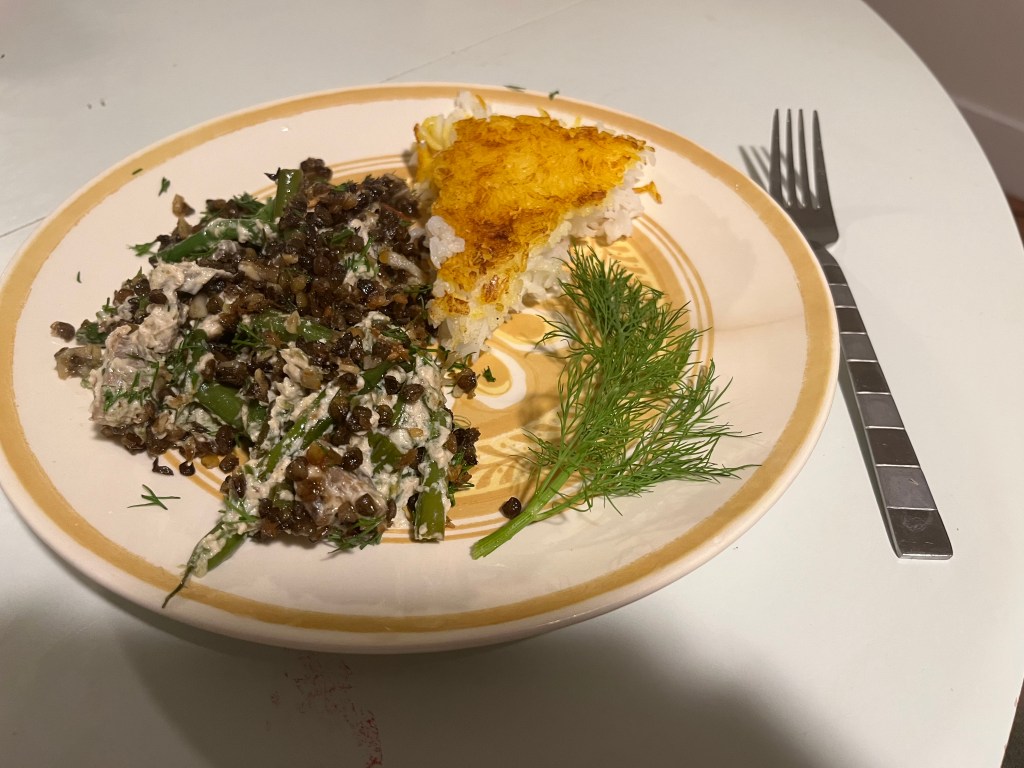
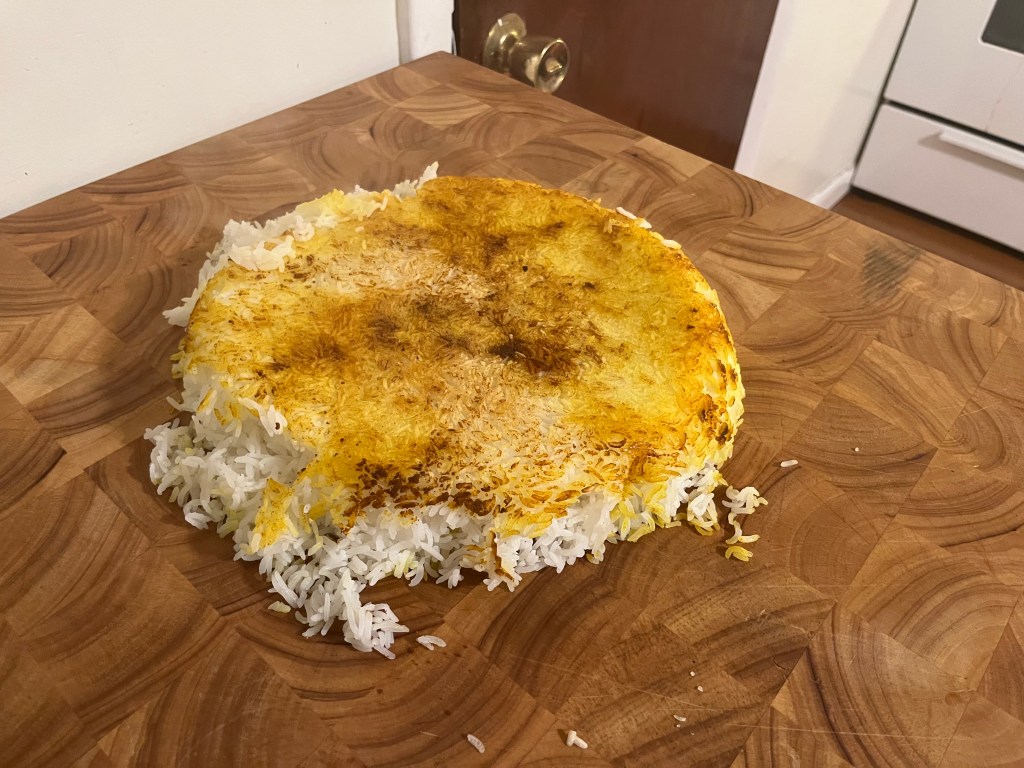
Cooking Notes: You’ll want to get the lentils pretty crispy. Only the thinnest garlic pieces will be brown at this point but that is OK. The oil will froth up almost like a candy sugar as it is approaching soft crack. Look for the bubbles to get to a medium brown before removing from the heat. The lentils will be somewhere between crunchy and chewy. The Persian rice will come out great if you stick to the recipe very closely; after trying to make Persian rice according to a different recipe, I quite appreciate the detail in this one and will be returning to get the crust right the next time I make it. A wide pot will produce more of the crispy bottom layer – I used a 7 qt. enameled dutch oven for a 1.5x batch; however, I recommend moving the pot around over the burner so it crisps evenly. Note that a lot of the magic of the different textures of this dish will be gone the next day, so plan to eat it right away! I recommend using extra turmeric on the rice to really highlight the complexities of that spice (assuming you find a high-quality product.)
The Persian rice would not fit on any serving platter, so I used my butcher block instead.
Tasting Notes: This is a phenomenal (vegan) dish! Note that the Persian rice was not a recommended pairing in the book, but I wholeheartedly recommend it. Both the rice and the lentils contribute a crunchy/chewy texture that contrasts nicely with the creamy soft beans and mushrooms. The inspiration behind the dish is apparently the classic Thanksgiving bean and mushroom casserole found on the back of the Campbells cream of mushroom soup can. This version is far better than any other I have had. Imaging for a second that some day you are tasked with making such a casserole for a Thanksgiving feast. If you were to show up with this dish, you would steal the show. The fresh dill, earthy-roasty lentils, and tahina all contribute to a very complex flavor to complement the complex textures. The Persian rice had almost a floral note from all of the toasted turmeric. Joe’s Rating: 7.5 / 7 (Beans / Rice) Difficulty: 5 / 5
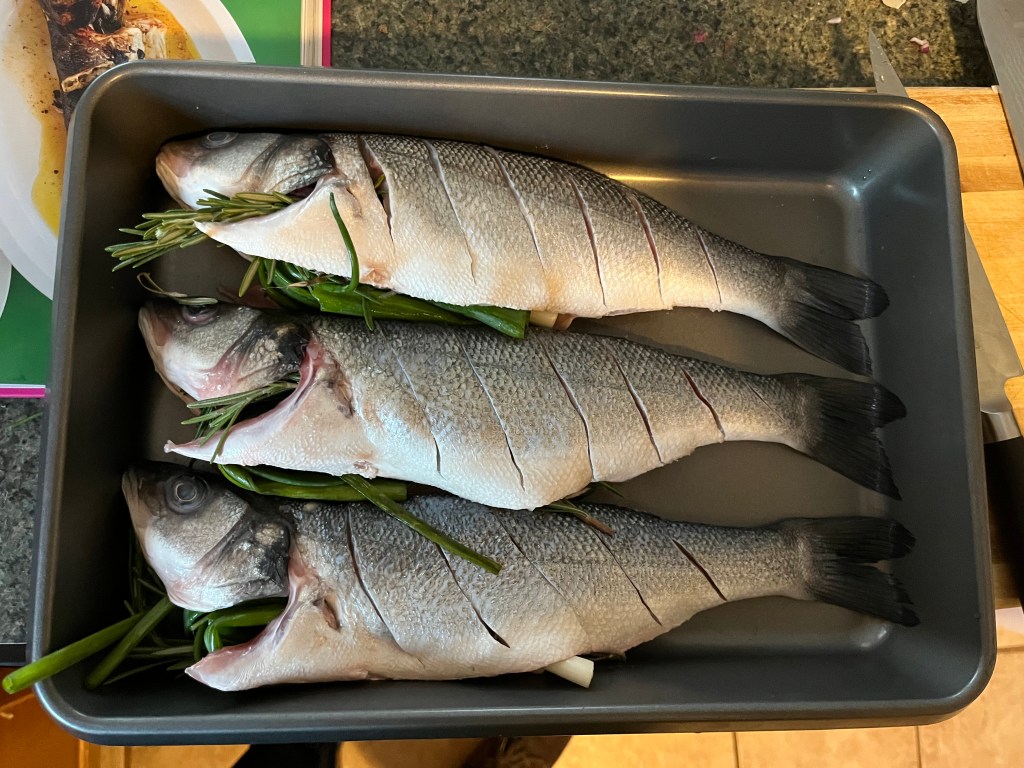
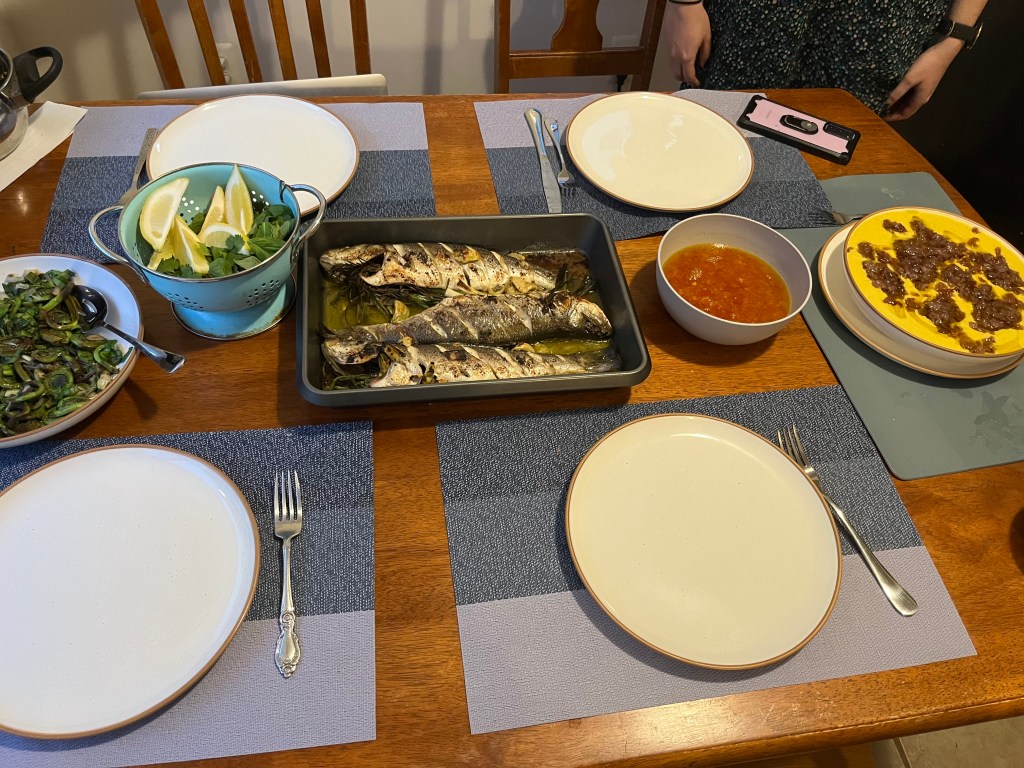
Brown Butter Sea Bass with Tangerine Dipping Sauce and Lots of Herbs I got three branzinos from Whole Foods to roast for this dish. The idea was to roast the fish basted in a browed citrus butter, then to sever the fish in family style where guests can grab chunks of fish and wrap them up in a piece of lettuce like a taco. Some herbs and a refreshing citrus dipping sauce are served to go with the fish filling. People liked this more than I thought they would; the lettuce wrapper was less fussy than I expected. Joe’s Rating: 6.5 Difficulty: 4.5
Cheesy Polenta with Curried Onions This was an attractive starch to pair with the fish and spring vegetables. The resulting dish was very rich and delicious; the combination of Gruyere and miso worked really well; however, I believe it would be better suited to a cold-weather dinner. The only cooking note I have is to make sure you follow the instructions on your polenta to get the right consistency, rather than the ones in the cookbook (which I found was way too runny for my polenta.) Joe’s Rating: 7 Difficulty: 4.5
My friend Sophie and I have long wanted to cook a dinner from the cookbook Le Pigeon. It is a cookbook from a restaurant in Portland, OR that specializes in offal and game. I have been to the restaurant twice and loved it. My one experience with the cookbook was for a 3-course dinner party I made in January 2018. (Someday I hope to update this blog with my past notes on such dinner parties.) The results were mixed – very interesting food, but with some obvious errors in the instructions. The errors were unusually overt and numerous for a modern cookbook from 10-Speed Press. We approached these recipes with caution and were rewarded with an amazing meal!
Course 1: Hamachi, Foie Gras, Truffles, Mandarins I checked out “The Mushroom Shop” in Somerville for the first time, and I was surprised to find fresh summer truffles from Spain, morels, nettles, chanterelles, and other goodies. I chose this ceviche to include the truffles and some foie gras (which seems appropriate for a Le Pigeon dinner!) I was able to find hamachi sashimi at my local Japanese market. The resulting dish made a nice appetizer. The creamy home-cured foie added an important textural element to the citrusy, truffly ceviche. Sadly, I forgot to take a picture, but it looked very nice. Joe’s Rating: 7 Difficulty: 6
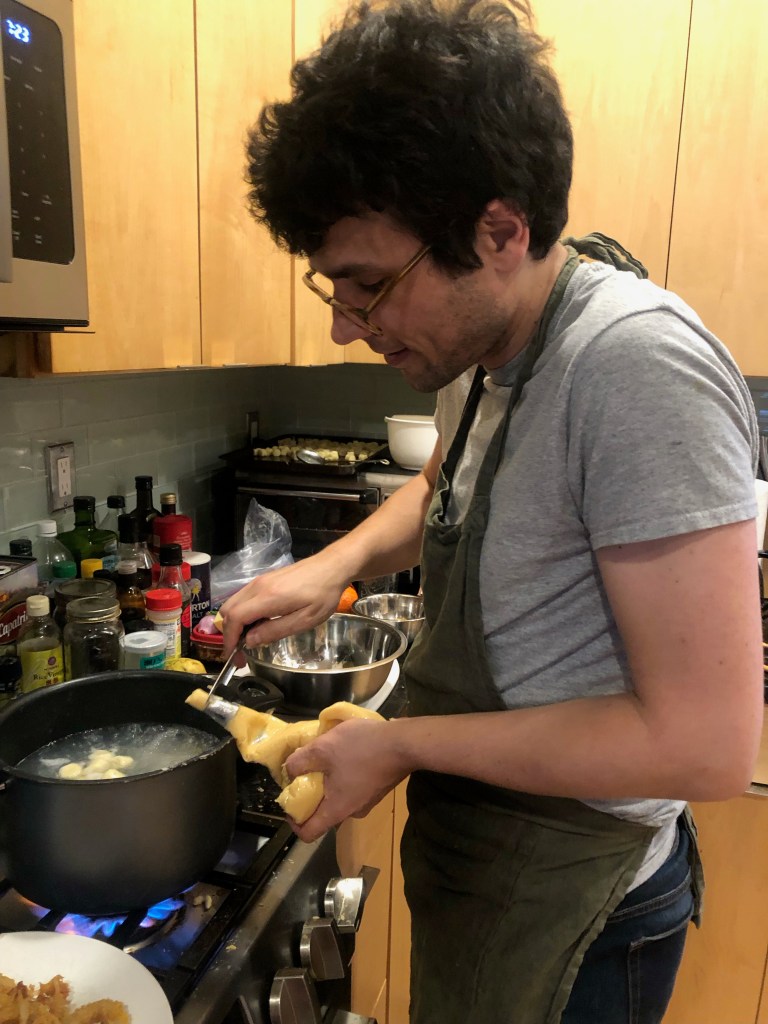
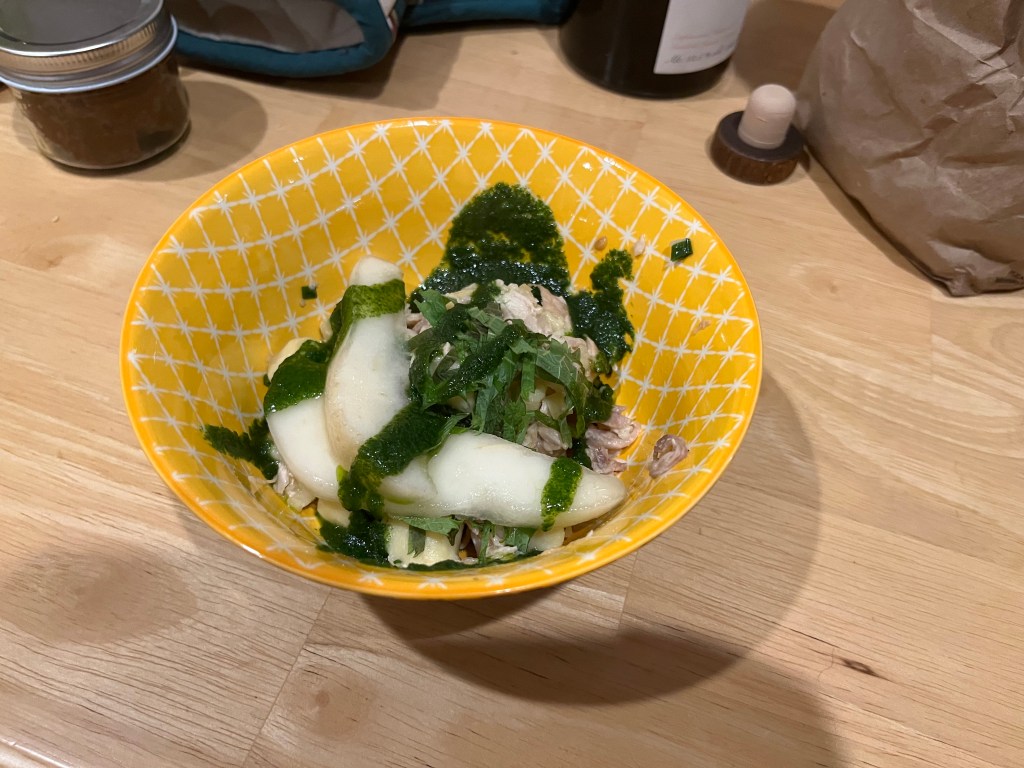
Course 2: Pheasant Gnocchi, Sake Pears Poaching pheasant and pear in sake caught my eye. I used a blend of 2/3 regular dry sake and a 1/3 super-funky “yellow-can” sake. The funky sake worked really well for the pheasant, but made the pear taste like a banana (in a really convincing way.) I’d recommend using a 50/50 blend for the pheasant and using 100% clean dry sake for the pear next time. The gnocchi were made with 100% flour and no potato, which tasted boring by itself but was very good at absorbing the flavor of the pheasant stock. The gnocchi were made using a piping bag. This is something I always have wanted to do after seeing many contestants on Top Chef use the technique; I included a picture of me doing it below. It worked really well! Finally, the dish includes both parsnip and shiso leaf in ways that make the flavor addictingly complex. This makes more than 4 servings, so you’ll have leftovers for everyone.
Joe’s Rating: 7.5 Difficulty: 7.5
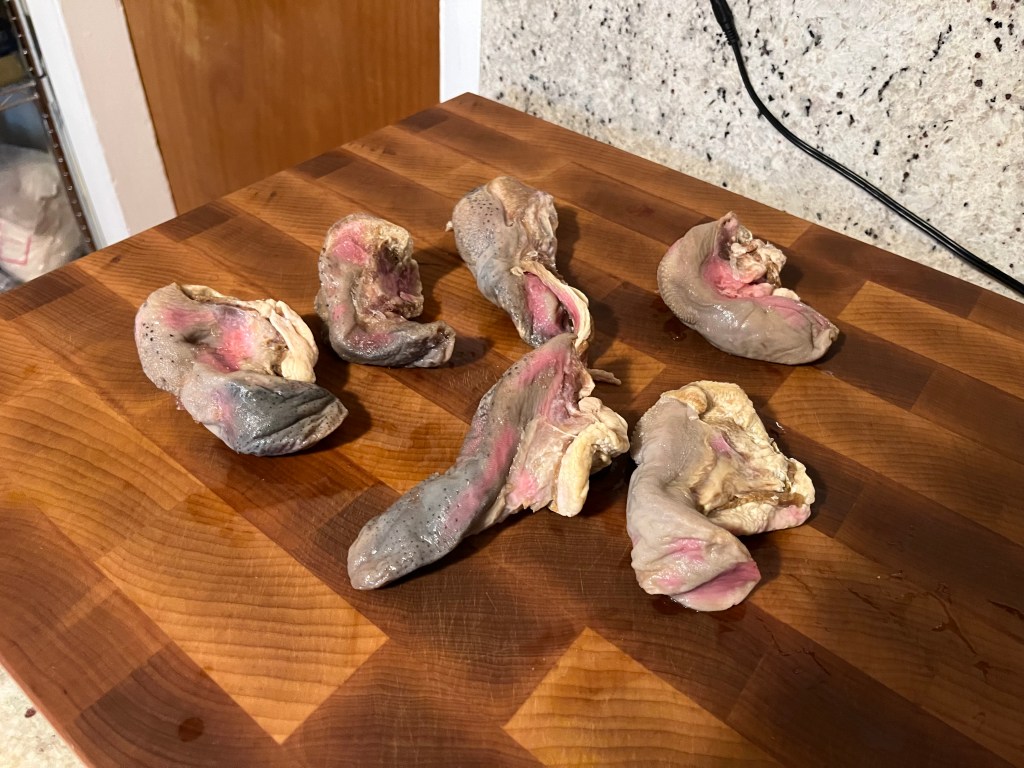
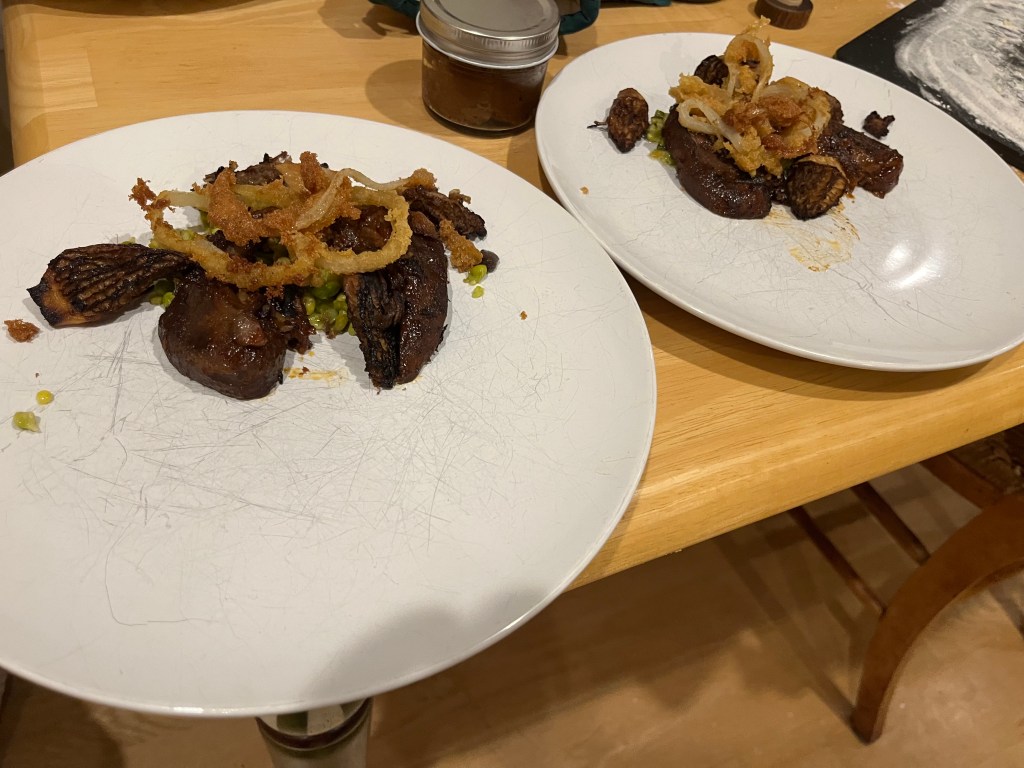
Course 3: Grilled Lamb’s Tongue, Creamed Peas, Morels In a cookbook focused on offal and game, peas, morels, and the charcoal grill would have to be our seasonal note. I got the lamb tongues incredibly cheap from Savenors in Cambridge; this was nice because I actually needed to get them twice. The first time I tried braising them, the liquid dried up and they got tough, so I needed to start over. I recommend making double the amount of wine in the braising liquid (with only 1x the amount of spices.) Also, there is a type in this recipe – only use 1 tsp of salt, not 1 tbsp. I braised for an extra half hour than suggested.
The dish was our favorite of the bunch; the tongues were incredibly tender, and the BBQ sauce was not overly sweet despite my concerns. The morels were juicy and crunchy; I’ve never had them so fresh or good. A knockout dish! Just make sure your include enough braising liquid. Joe’s Rating: 8 Difficulty: 8
Course 4: Apple Cheddar Crostada, Choose-Your-Own Condiment Sophie took the lead on this one. I loved the savory cheddar notes mixed into the sweet and flaky crostada. We used a sweet wine pairing, but next time I would choose a dry pairing (I was thinking an oxidized Jura savagnin). Joe’s Rating: 7 Difficulty: 5
While exploring different Asian cuisines, I have often overlooked Indonesian food in favor of Thai food. There is really no justification for this as I have loved the Indonesian food I’ve cooked and tasted (e.g. Gado Gado in Plenty). Fire Islands by Eleanor Ford seems to have recipes that are as highly regarded as its cover is beautiful. Let’s give it a try!
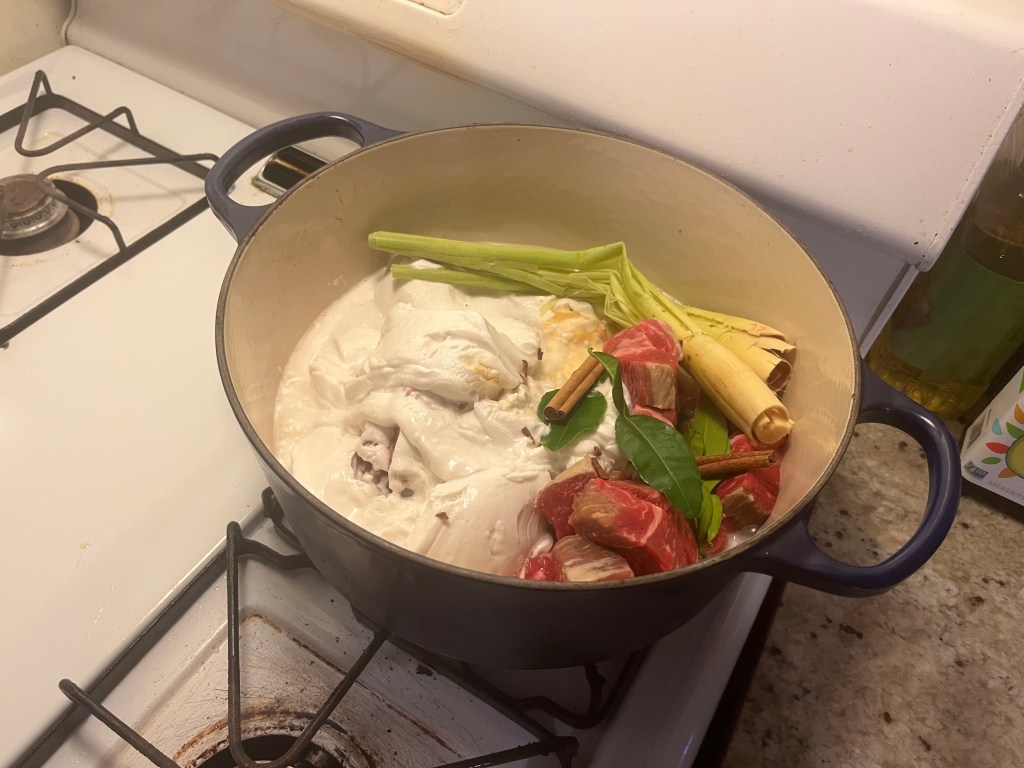
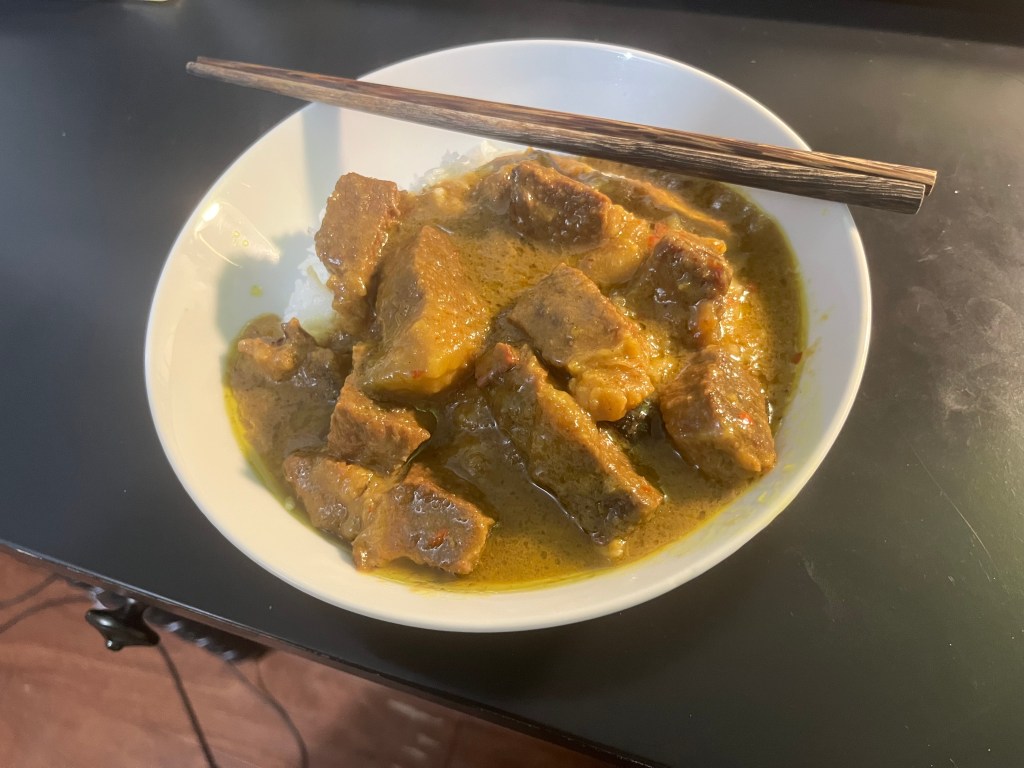
Beef rendang is one of the most popular Indonesian dishes. It is a simple and indulgent beef braise. Its richness derives from the huge amount of coconut milk used in the braise (100% of the liquid, and it is reduced for hours as well.)
The dish turned out great. There is plenty of thick sauce to go with rice. I made a slightly larger batch (1.5x) and found that cooking it for 3 hours instead of 2 resulted in a better consistency. It would be good to pair with some vegetables; fortunately, Fire Islands has extensive menu options for every recipe. I elected to also cook a vegetable stir-fry.
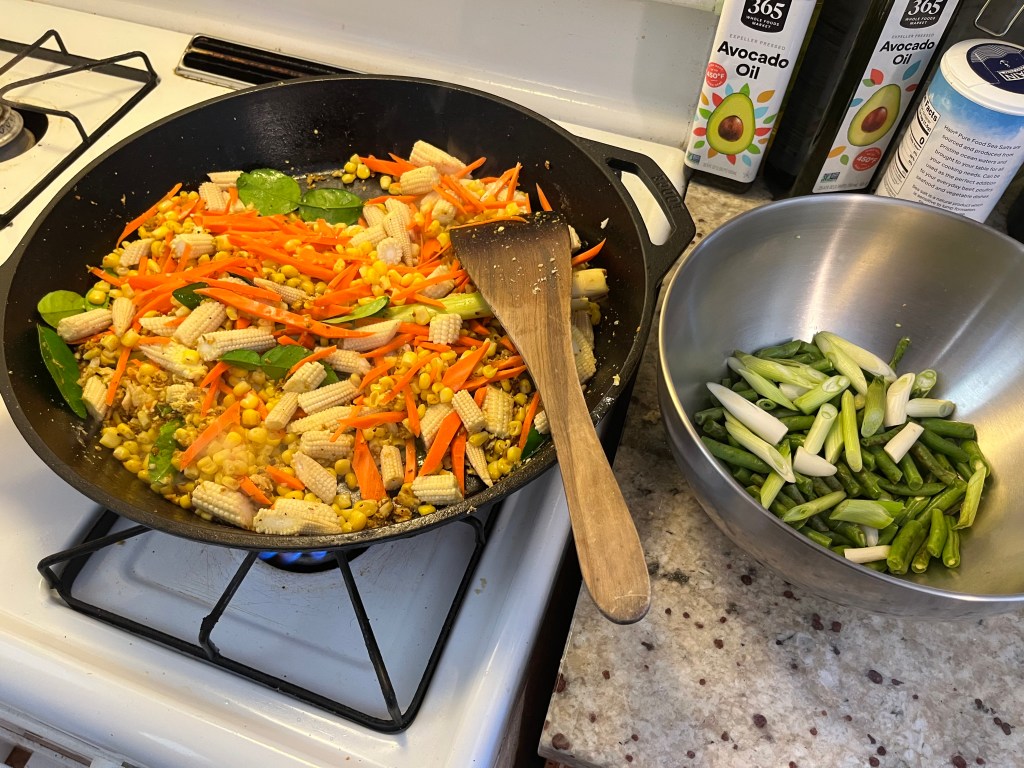
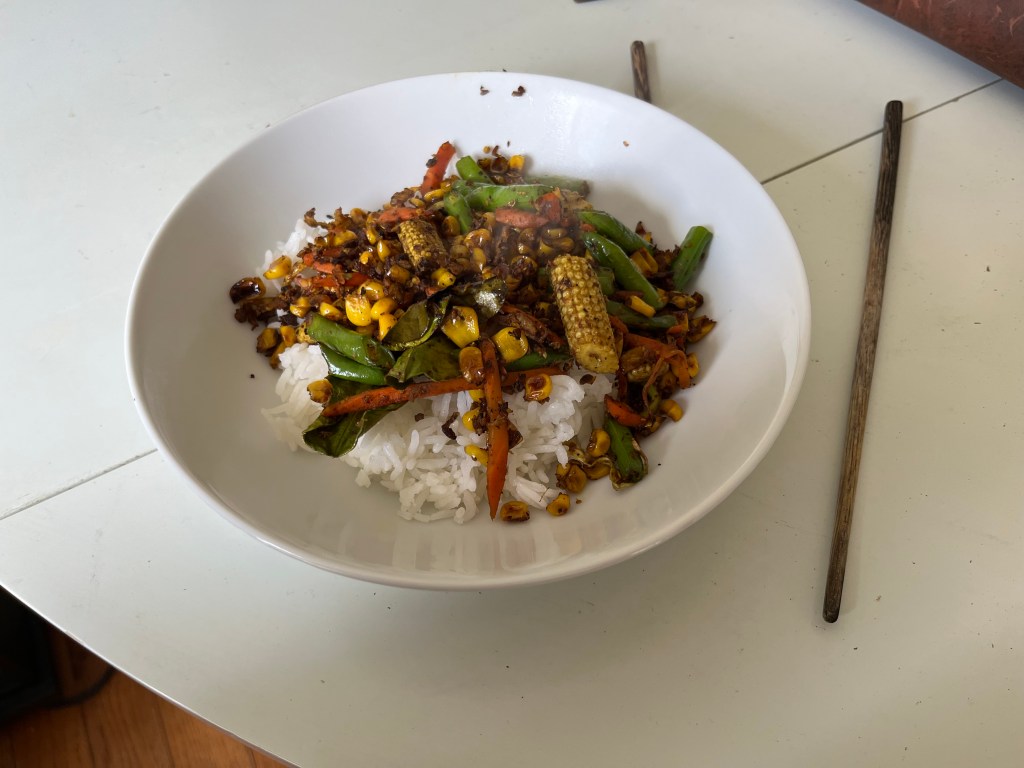
The golden-vegetable stir-fry focused on corn. It would probably be best to make this one when corn is in season, bet it was tasty and attractive even with frozen corn. I was able to get the baby corn at my local Asian market (Hmart). It could use a little more oil in the stir-fry, but otherwise the preparation was straightforward.
The dish was not as intensely flavorful as the rendang, pretty dry and healthy, not that oily. Good accompaniment for something saucier like beef rendang.
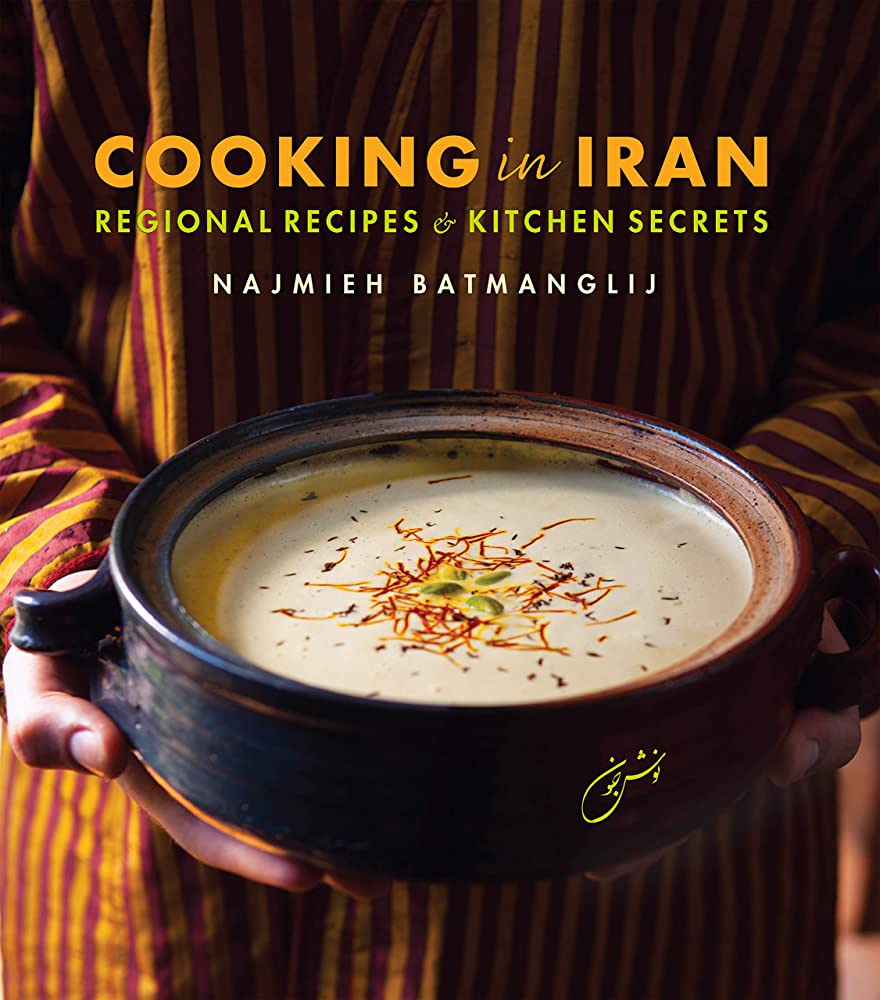
Food of Life, written in 1986 by Najmieh Batmanglij, is a thick classic English-language Persian/Iranian cookbook. One of her more recent cookbooks, Cooking in Iran: Regional Recipes & Kitchen Secrets, is a large tome with many pictures broken down into 17 different regions of historical Persia. It is not quite as popular as Food of Life (based on the number of reviews) but I still opted for this book because I like the regional focus.
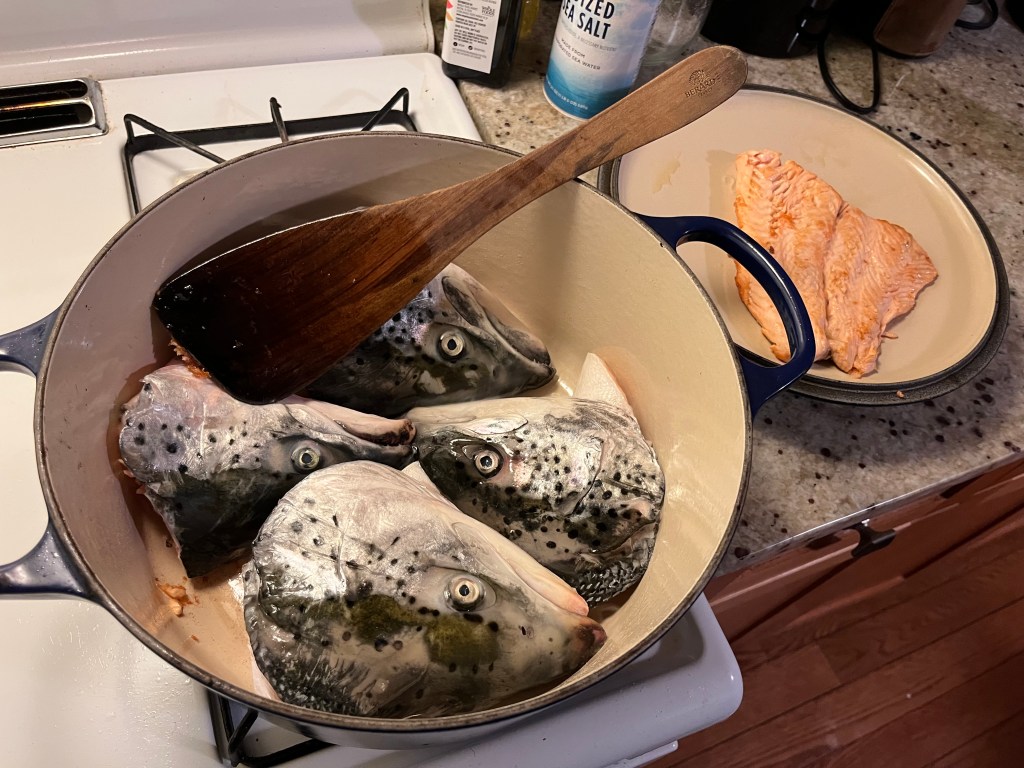
Fish-Head Soup is from Rasht and featured in the Caspian section of the book. It required me to order some ingredients I hadn’t used before: grape molasses and golpar (dried Persian hogweed). I was lucky enough to get 4 salmon heads from my local Asian market.
Cooking Notes: the heads stick! Try getting pan hotter. Stir and simmer the salmon heads very gently so that they don’t disintegrate. Go light on the saffron; throwing a whole pinch directly into the pot was a bit too much!
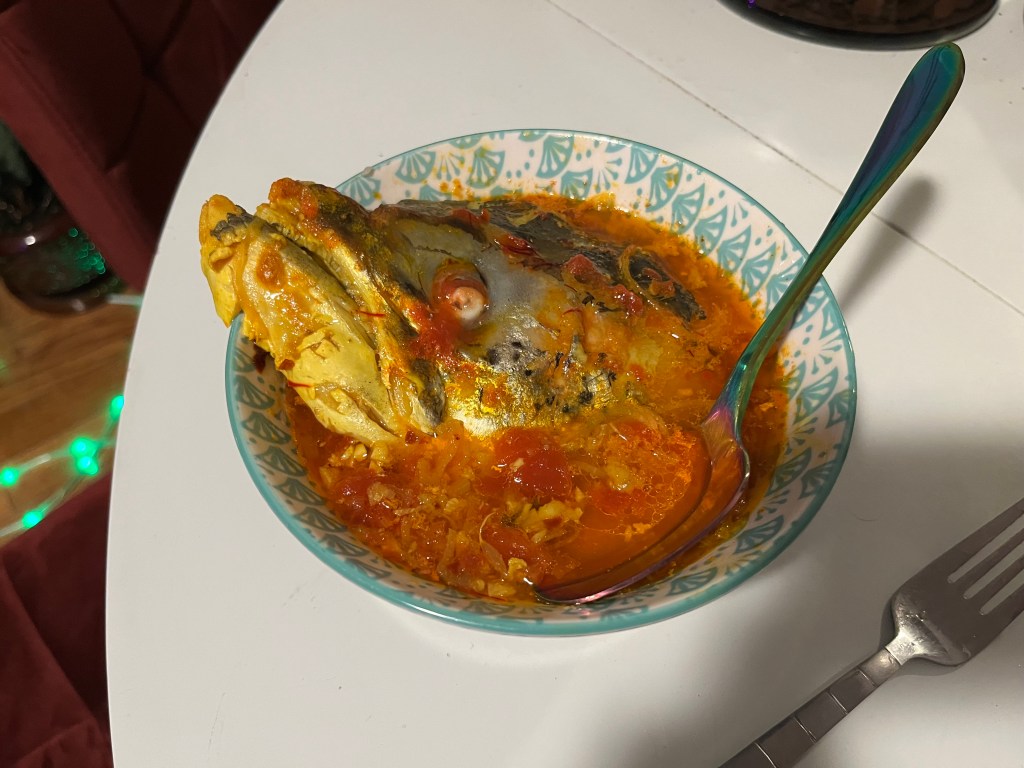
Tasting Notes: Yummy fish soup with a strong saffron flavor. I wish the saffron were a bit lighter so I could taste the Persian specialty ingredients. Nonetheless, the saffron flavor is good. The one thing that I didn’t like was picking out the various plate bones that fell out of the fish head. I need to cook the heads more gently in the future. Also, the eyeball (seen in the image) fell out of the eye socket and was very unappetizing – it was surprisingly big; about the size of a quail egg!
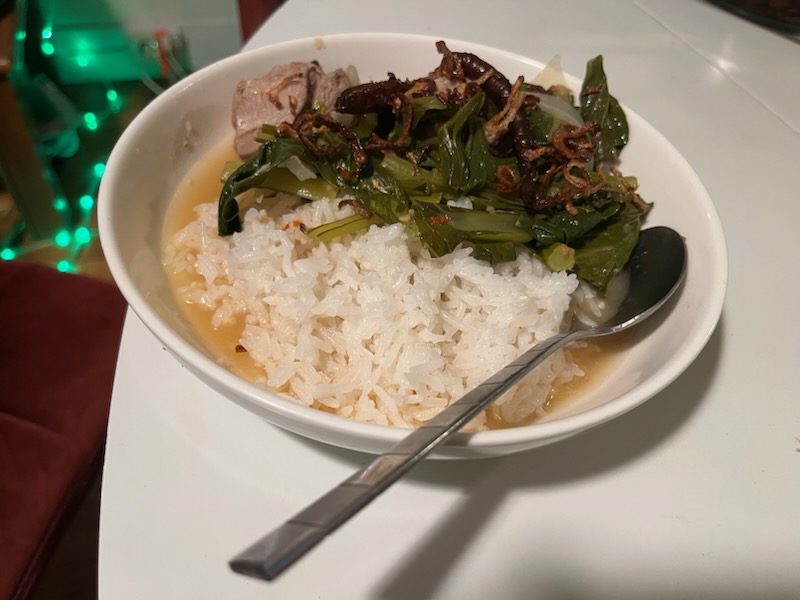
As promised, here is a dish from Pok Pok, a Thai cookbook that has lots of detail and context for every recipe! I selected a mustard-green (yu choy) and pork soup.
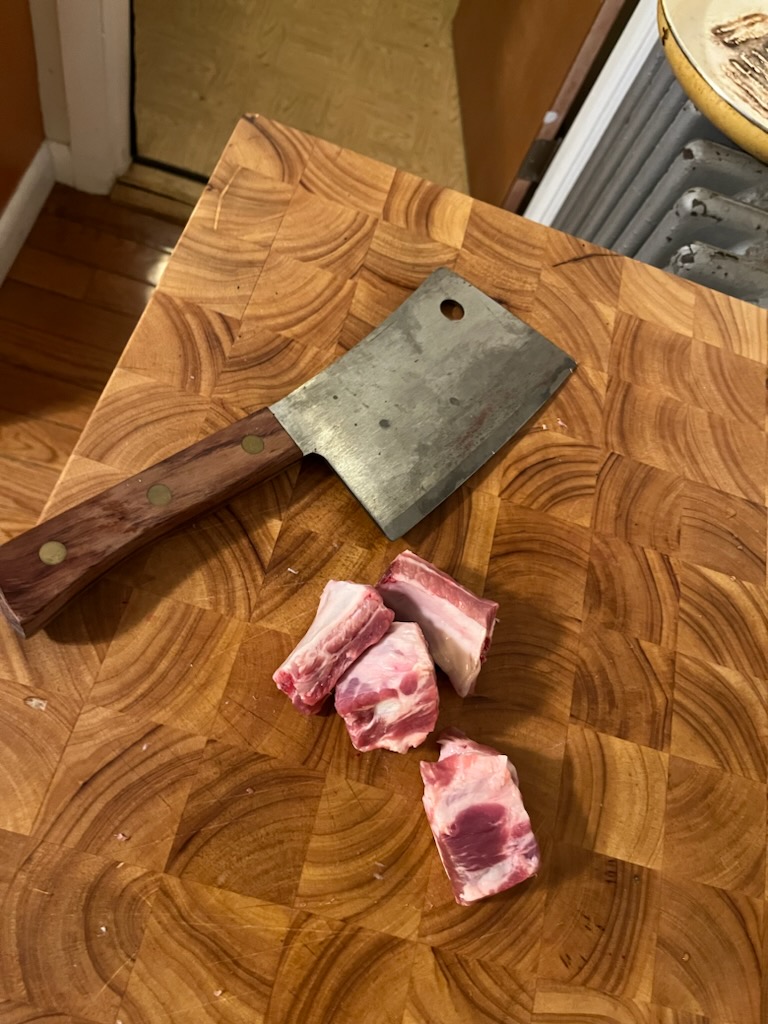
Cook the pork longer than it says to. The soup can take more salt if you want. It needs rice or another starch. Handy Dexter 7″ butcher knife works fine for breaking up the ribs. It was actually kind of fun chopping them up!
The yu choy is mild in the soup. Not the most intense Thai flavor. The pork in particular can use more salt, so either salt more earlier or keep some malden nearby.
If you are not familiar with Phaidon’s “__________: The Cookbook” series, they can be hit-or-miss. This is a series designed to be visually appealing on the coffee table. Some are excellent to cook from, some have errors in the recipes, all are beautiful. I had a hankering for some Thai food, so I decided to give Thailand: The Cookbook a try. The author, Jean-Pierre Gabriel, is not listed on the outside of the book, which I take as a worrying sign. On the other had, every recipe is associated with a distinct region of Thailand, which is cool, so let’s reserve judgement.
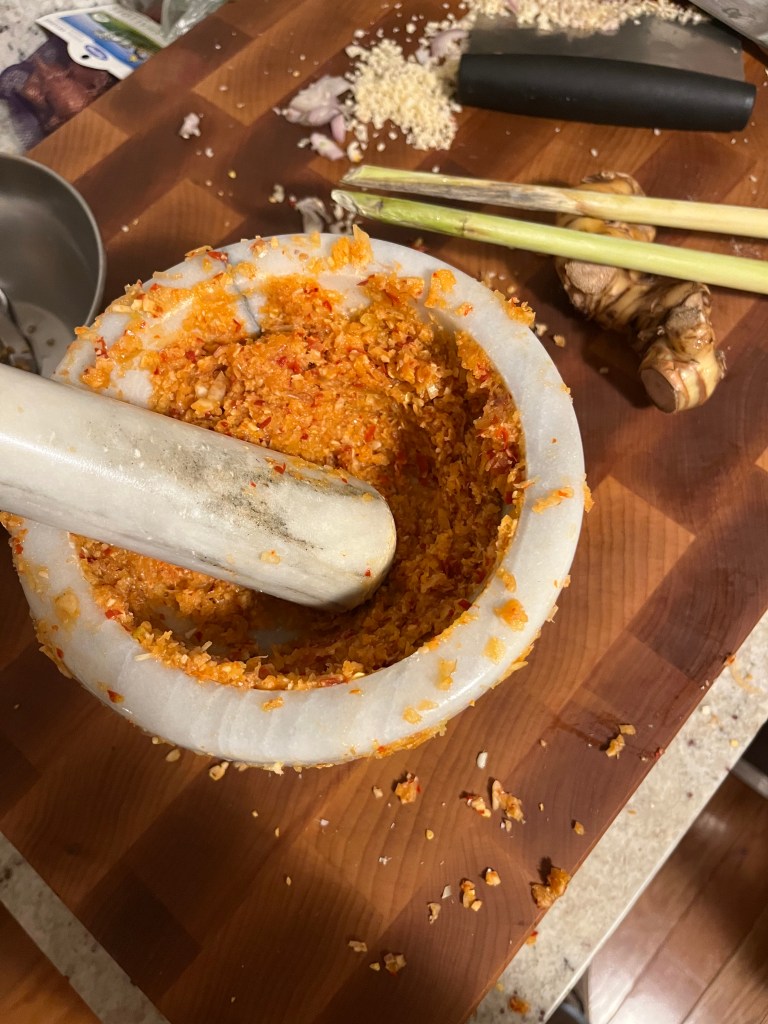
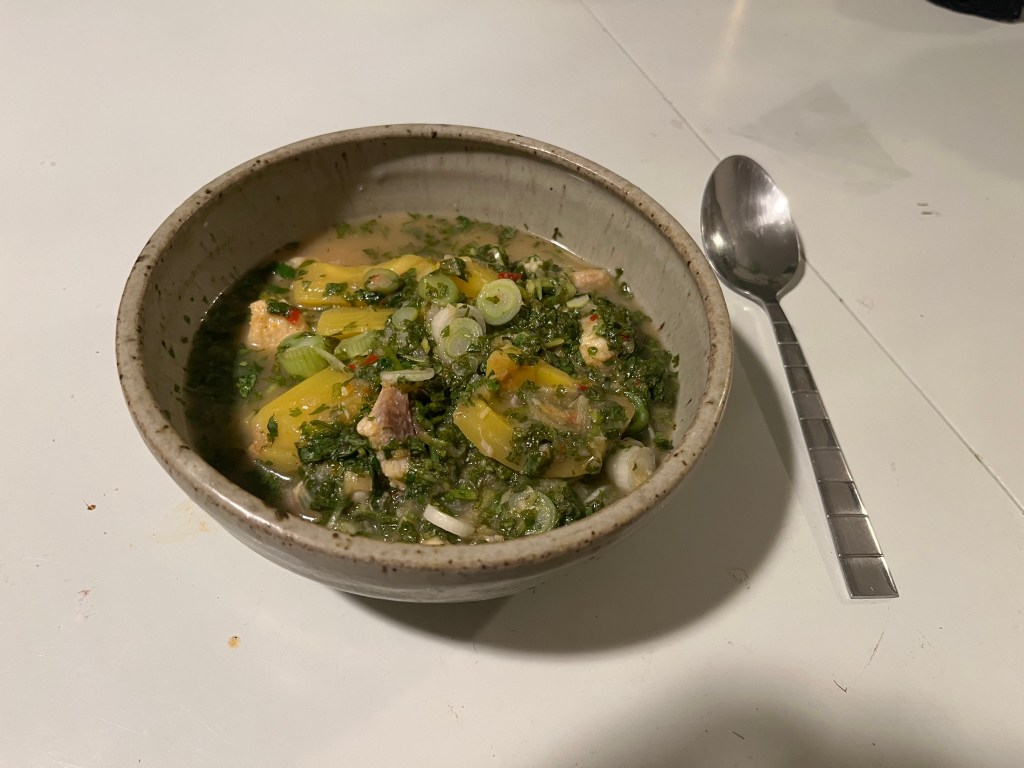
Spicy Catfish and Jackfruit Curry, a recipe from the northern region of Thailand, checks a number of boxes for me: I get to work with catfish and jackfruit, both new ingredients for me. This also has a notable amount of galangal in the curry paste, which I have not worked with in a couple years. It’s also a curry that I can make heaps of and eat for a few days.
Cooking Notes: The curry paste did not get as uniform as I would have liked (see image), but I think this was ok. I used fresh catfish instead of dried and reduced the amount of water in the base by 1.5 cups, which was perfect. The added 2 tsp of sugar was totally unnecessary. It comes out more of a stew than a curry texture. Next time, I would experiment with blending the liquid, paste, and a portion of the jackfruit into a thicker curry sauce. There is a lot of jackfruit in the balance, so blending a bit while cutting sugar will help to consume it more evenly with the catfish. Save the greens additions for individual serving garnishes if you are preparing for others. Note: this book generally doesn’t make explicit salt additions, so make sure you are doing them.
Tasting Notes: The flavor is very good: sour-sweet with a bit of heat (a bit too sweet, but would be good cutting the sugar / also consider adding tamarind to taste). If I was making it for myself in the future, I would add a few more chiles. The texture is a bit soup-like. Goes well with rice, but also as a bowl of soup. The galangal did not stand out, which surprised me given its strong medicinal aroma. Rather, I did get a distinct note of fish sauce, which was still in balance. The cilantro and green onions were also added in large enough quantities to give it a fresh herbal note. The jackfruit was lovely; I noticed a lot of variation in the intensity of aroma between the two pre-wrapped chunks I bought. Make sure you do a smell test in the store. The catfish was denser and meatier than I was expecting, maybe a bit more dense than bass. I recall thinking: good chicken substitute, although it’s still not that dense.
The overall dish is nice. I wish the sauce were saucier, but the flavors carry the dish. Still, with only 5 sentences of instructions, I found it difficult to to learn much in terms of technique or to know if my version of the dish approached the original. I’m looking forward to trying another Thai adventure with Pok Pok, a cookbook with fewer regional and obscure dishes while being much more detailed with context and instruction.
I’ve recently been experimenting with both collaborative dinner parties and collaborative dish imitation “workshops” rather than my usual solo cooking endeavors. I’ll get back to you about the latter in another post, but here I’m trying out my first collaborative 4-course dinner party! The menu was inspired by my friend Sophie’s desire to cook a red-wine risotto, which led us to design a four-course menu from Emelia-Romagna, where a rosemary red-wine risotto is traditionally served with game.
I turned to a new (for me) cookbook devoted exclusively to Emilia-Romagna: The Splendid Table by Lynne Rossetto Kasper, which was awarded Cookbook of the Year in 1992 by the James Beard Foundation. Despite the ugly cover, I can attest that this book is indeed splendid! It’s length comes from plenty of context and ideas associated with the 200 recipes, rather than trying to cram in as many as possible. Each recipe features subsections for the main parts of the preparation and assembly of the dish as well as “Working Ahead” on exactly how far in advance every component can be prepared (which reminds me of Falestin), wine pairings, and numerous menu-pairing suggestions. It was very easy to build a four-course meal around a single dish. Thank you! A variety of dishes are featured that are both homestyle and fancy as well as contemporary and historical; e.g. there is a whole chapter devoted to “The Sweet Pastas of the Renaissance!” Cookbook of the year seems appropriate!
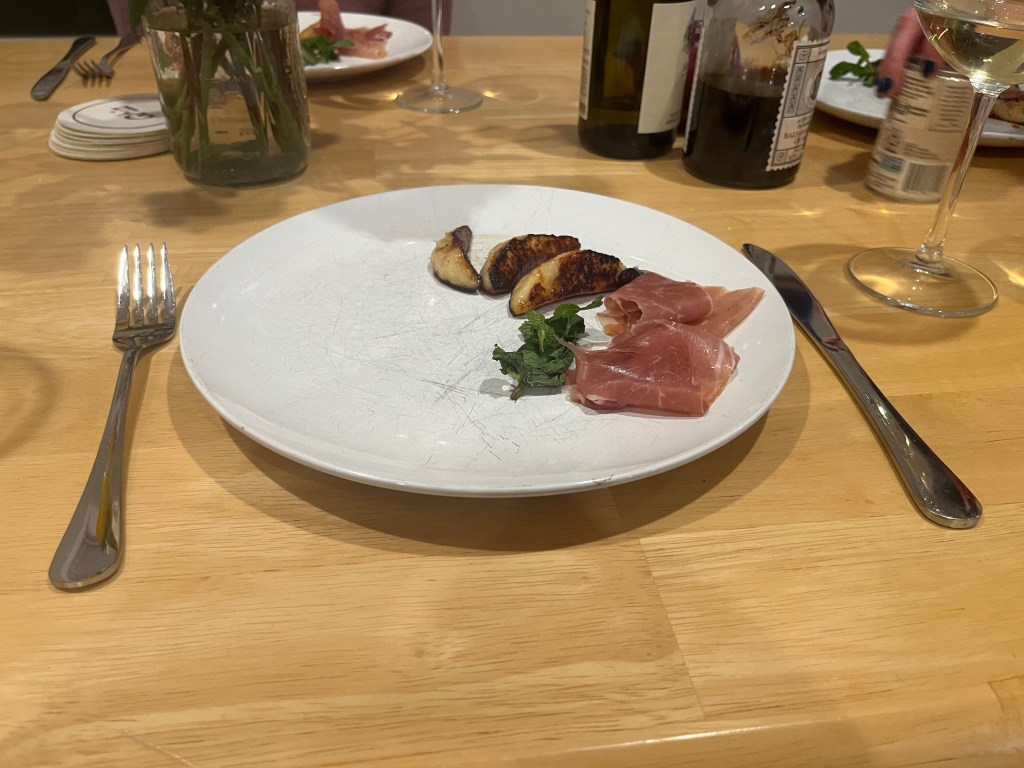
Antipasto: Hot Caramelized Pears with Prosciutto I could not find ripe bosc pears, so I had to substitute a red-skinned variety. I would recommended getting your pan smoking hot as it took much longer than expected for me to brown the pears and they became excessively oily. Otherwise, this dish was nice. The mint is important I think. I’d recommend finding the best prosciutto from an Italian specialty market that you are able to. Joe’s Rating: 6 Difficulty: 3
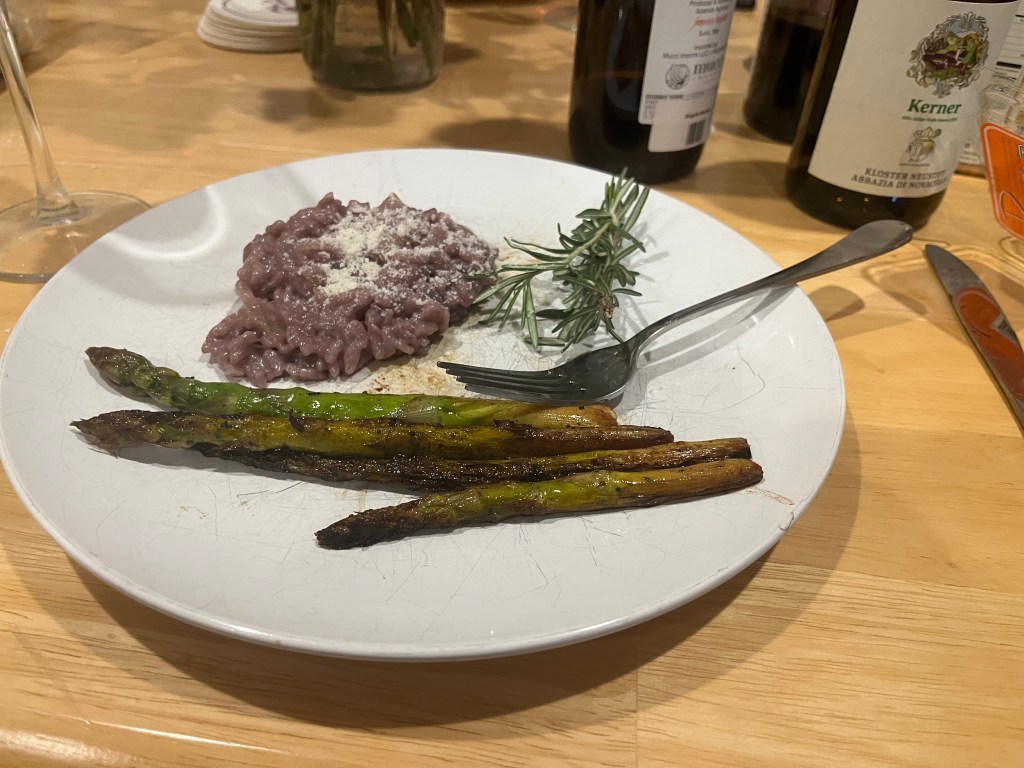
Primi: Risotto of Red Wine and Rosemary with Asparagus We used a barbera to make this. Despite being very acidic, I still felt the dish could use a little more acidity (or keep around extra wine to drink alongside.) Otherwise, very good! Joe’s Rating: 6 Difficulty: 4
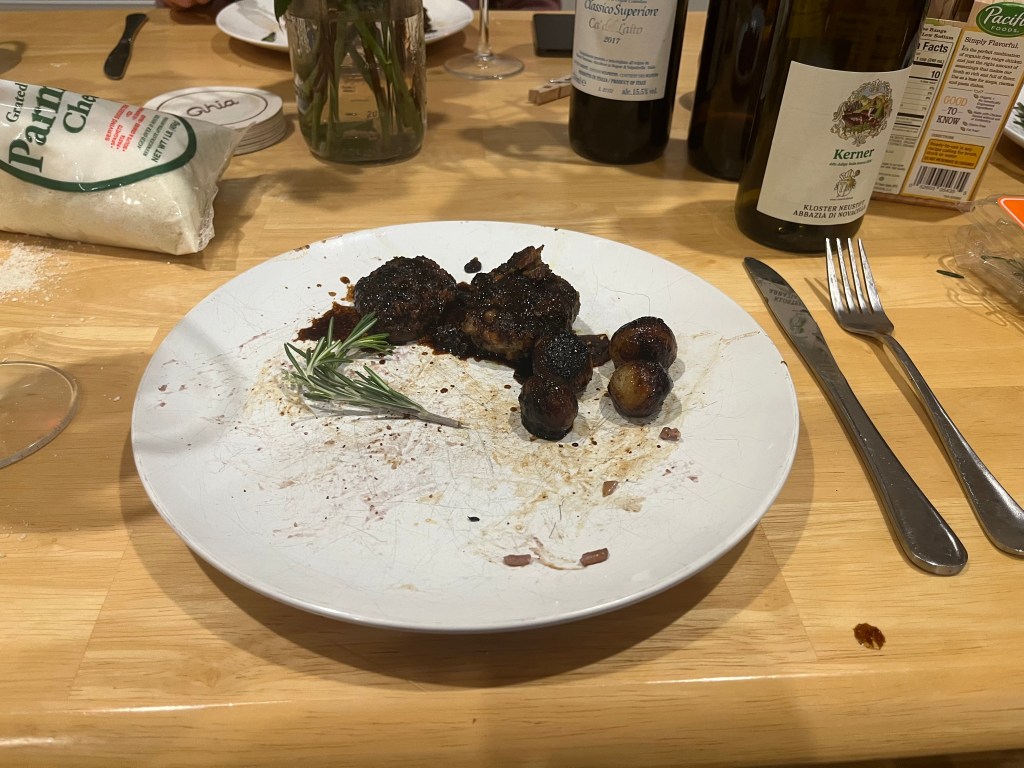
Secundi: Artusi’s Delight (Spiced Festive Meatball) For the main, we couldn’t find any affordable game, so we opted for this historical meatball (as indicated by the spice and sweet elements in this savory dish.) The meatballs (or, more accurately, patties) were soft, subtly spiced, and flavorful.
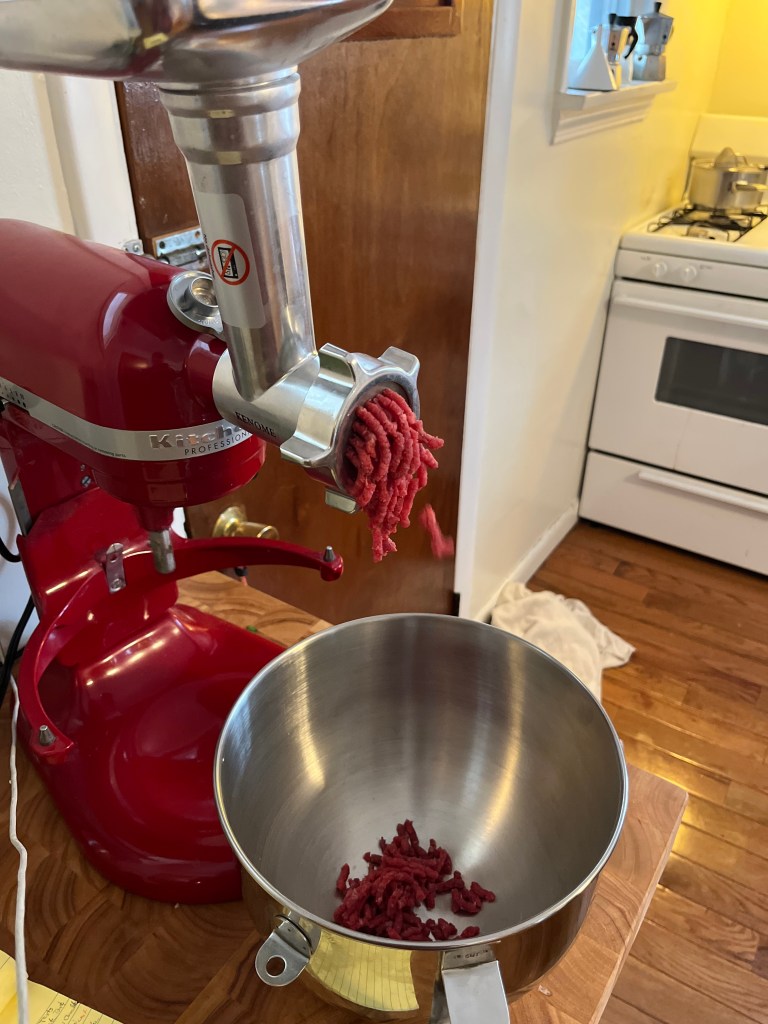
Notes: I decided to grind my own meats; to do this, I incorporated both the pancetta and the chicken thigh into a grind of sirloin-top rather than processing them. I figured this would create a better texture. Be careful not to char the patties; go low(ish) and slow. Could use a bit more salt (maybe at serving since this could change the texture of the patty.) It takes longer to reduce the stock than suggested. The sauce is excellent; try to get as much as you can out of it. Also, definitely make a double batch of the glazed onions! Joe’s Rating: 6.5 Difficulty: 6.5
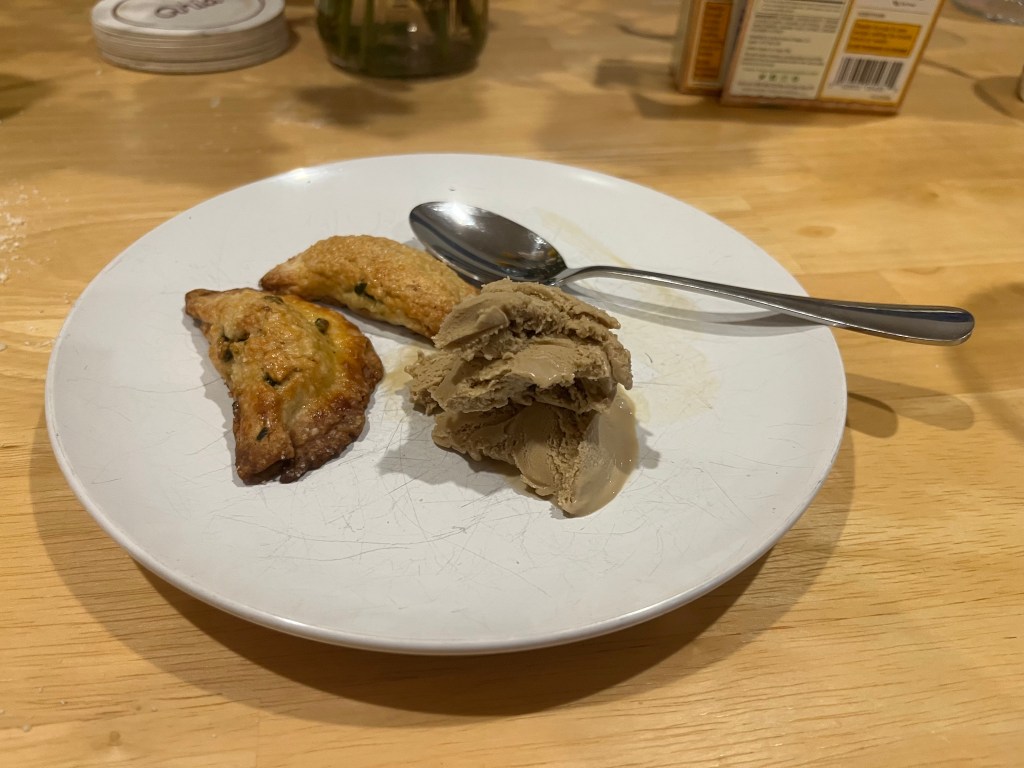
Dessert: Marie Louise’s Crescents These cookie-like spinach-filled pastries stood out to us because they invert the more common veg-to-fruit progression of a meal. We were also intrigued as spinach is a particularly unusual ingredient for dessert. If you are curious, these were thought to come to Emilia-Romagna from Austria by way of a court cook.
The dish was mysterious. Our guests spent a good couple minutes trying to guess what the “licorice”-like flavor was coming from. Note: there is nothing anise-flavored in the ingredients; that note comes entirely from the cooked spinach, toasted almonds, etc. When they found out it was spinach, all were surprised and entertained. The author recommends pairing this with coffee; since we did not have any at the house, we used coffee-flavored ice cream instead, which I’d highly recommend if you make these crescents. I also recommend using a vermouth in the pastry dough (I used Chambery blanc/sweet).
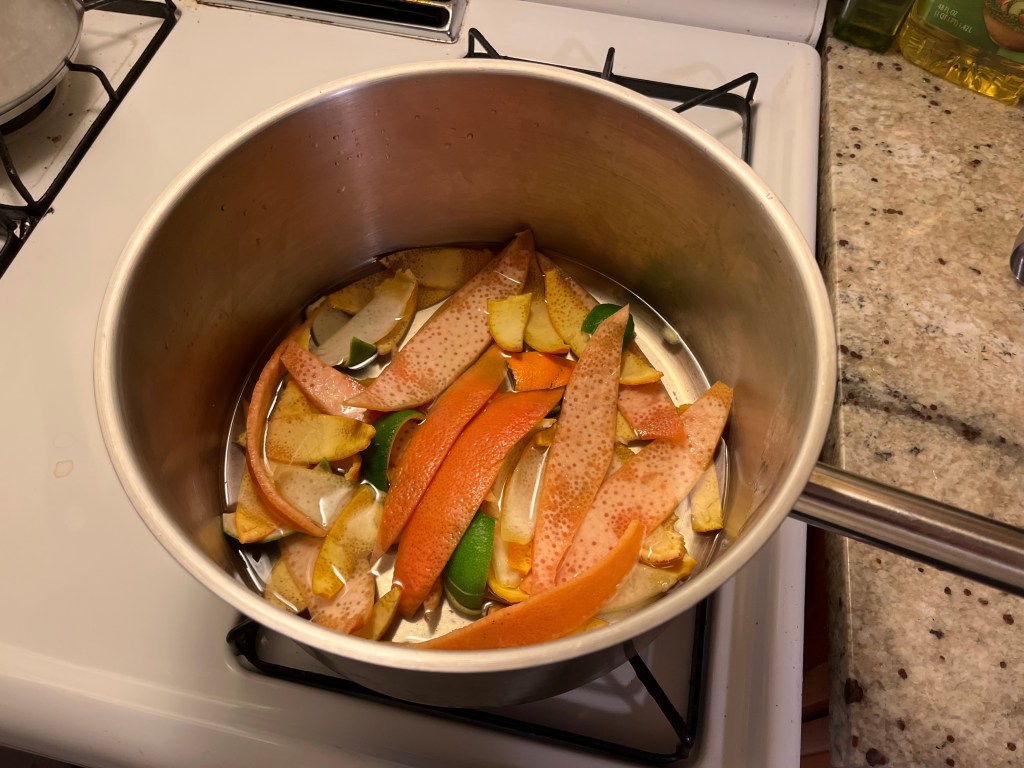
The recipe calls for candied citron (which is actually an entirely differently fruit than lemon). To substitute for this, I made an overnight version of homemade candied lemon, orange, and grapefruit peel loosely based on a recipe in the book “Southern Italian Desserts” by Rosetta Costantino. Be sure to cut the lemon peel fine as they may come out tough. The ripest fruit with the thickest rind seemed to work best.
Finally, note that the pastry dough is difficult to work with as it falls apart when strained; however, if you are careful to keep it under plastic and maybe spritz lightly with a water bottle, you can manage to get them together. Joe’s Rating: 7 Difficulty: 7
Despite having cooked approximately 20 Sichuan dishes from The Mission Chinese Cookbook and All Under Heaven, I had entirely neglected cooking any from the much revered Food of Sichuan by Fuchsia Dunlop. Looking for a quick stir-fry, I decided to do one last-minute tonight. This book turned out to be an excellent resource for learning about Sichuan cooking and eating; while it seems long, the first 60 pages of background material are packed with useful information for an aspiring Sichuan chef! The other cookbooks I mentioned familiarized me with basic ingredients and dishes of the region. The background material in Dunlop’s book covers the many canonical flavor profiles and cooking techniques as well as the different manners in which the people of Sichuan would value and enjoy a given dish. For example, texture is very important in Sichuan dishes. Reading this section made me really want to try fire-exploded kidney and jellyfish so I could see what all the fuss was about pertaining to their unique textures.
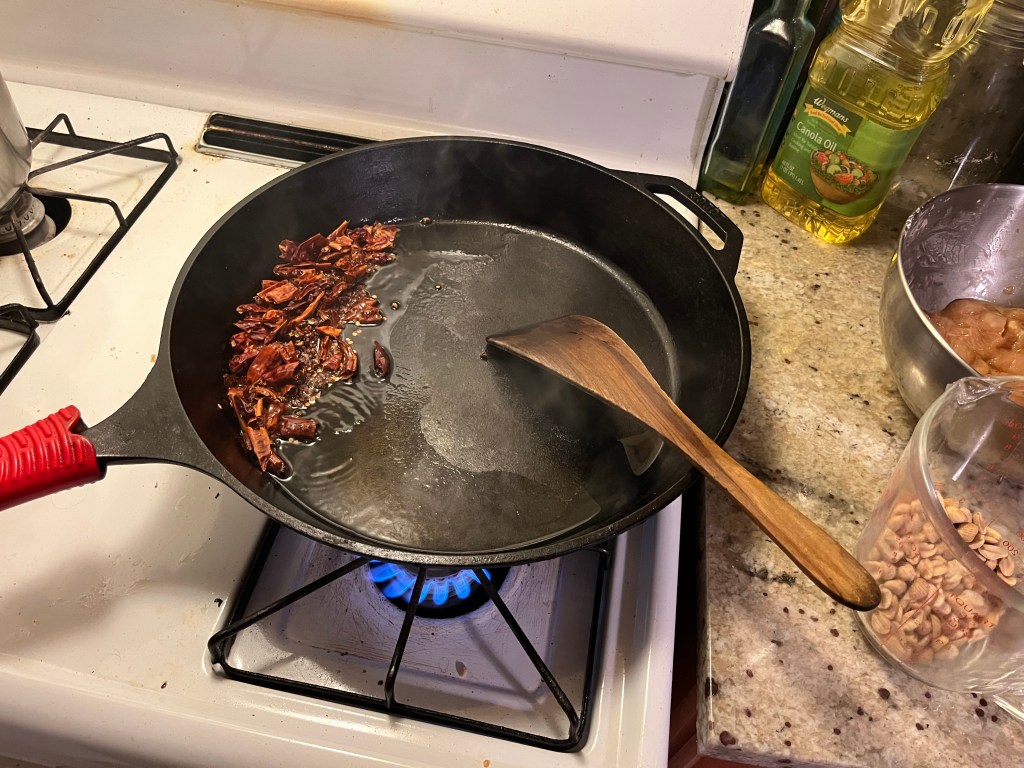
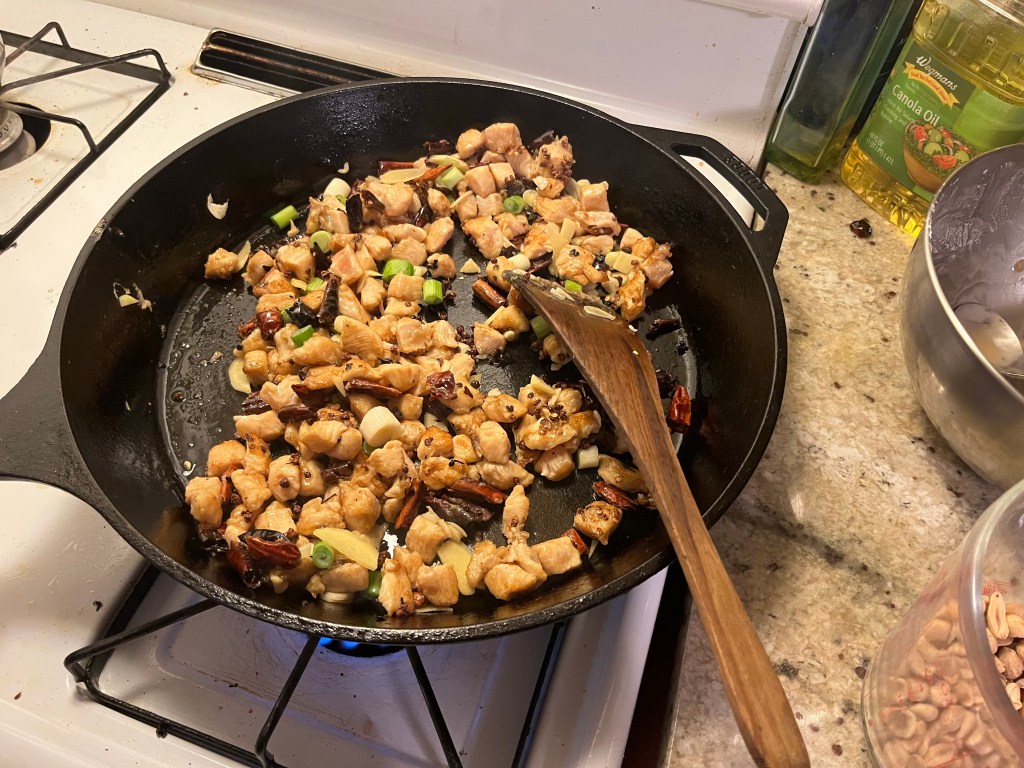
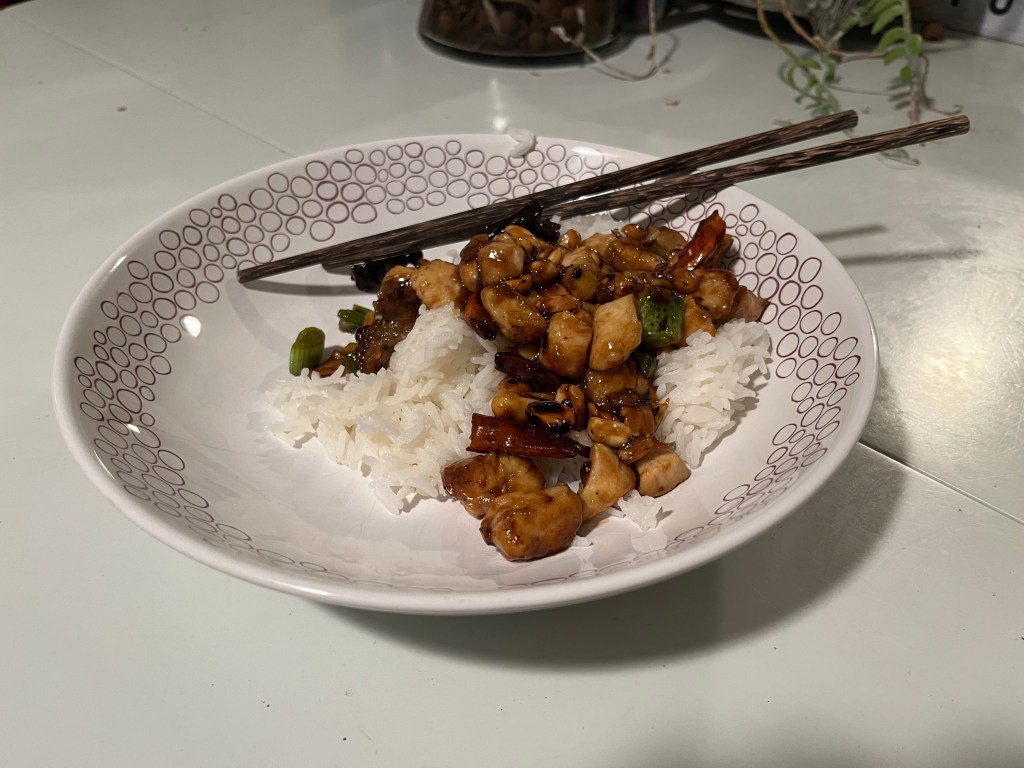
Gong Bao Chicken (also commonly transcribed as Kung Pao Chicken) is a Chinese stir-fry, meaning in a commercial kitchen it will be cooked over a burner with almost ten times the heat output compared to a residential stovetop burner. Because of this, I opt to use two burners on my 15-inch cast iron to get a similar effect. The heat builds up in the middle of the pan for when I need it to rapidly cook the chicken, but until then, I cook off to the side where there is less heat content.
This dish features a “lychee-flavored” sauce, meaning the flavor profile is sweet-sour (and does not actually contain lychee.) I took a lot of care to cut everything to even proportions, to good effect. I’d recommend doubling the number of chiles and peppercorns and throwing in a few extra scallions too.
Tasting notes: This dish was very good. It isn’t as spicy or numbing as some Sichuan dishes I’ve had, but perhaps that is appropriate for Gong Bao Chicken. The sauce works well, contributing gummy bits of deeply savory flavor when found in a bit.
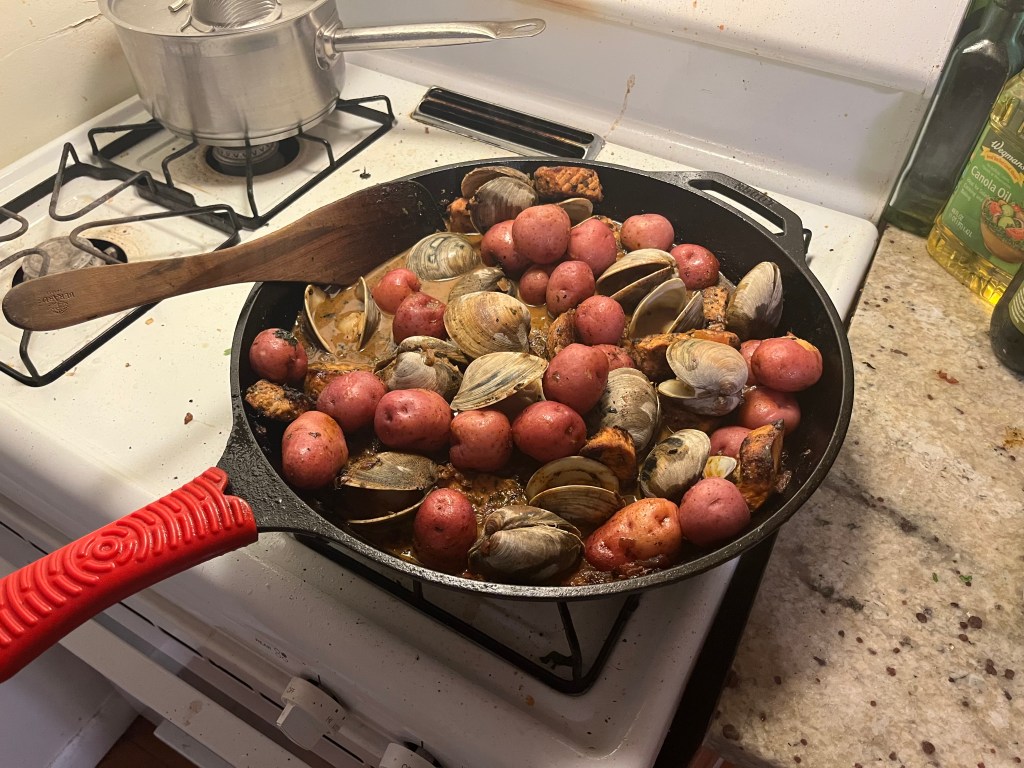
I had been meaning to try this classic Portuguese surf-and-turf dish for a couple weeks. Tonight was the night!
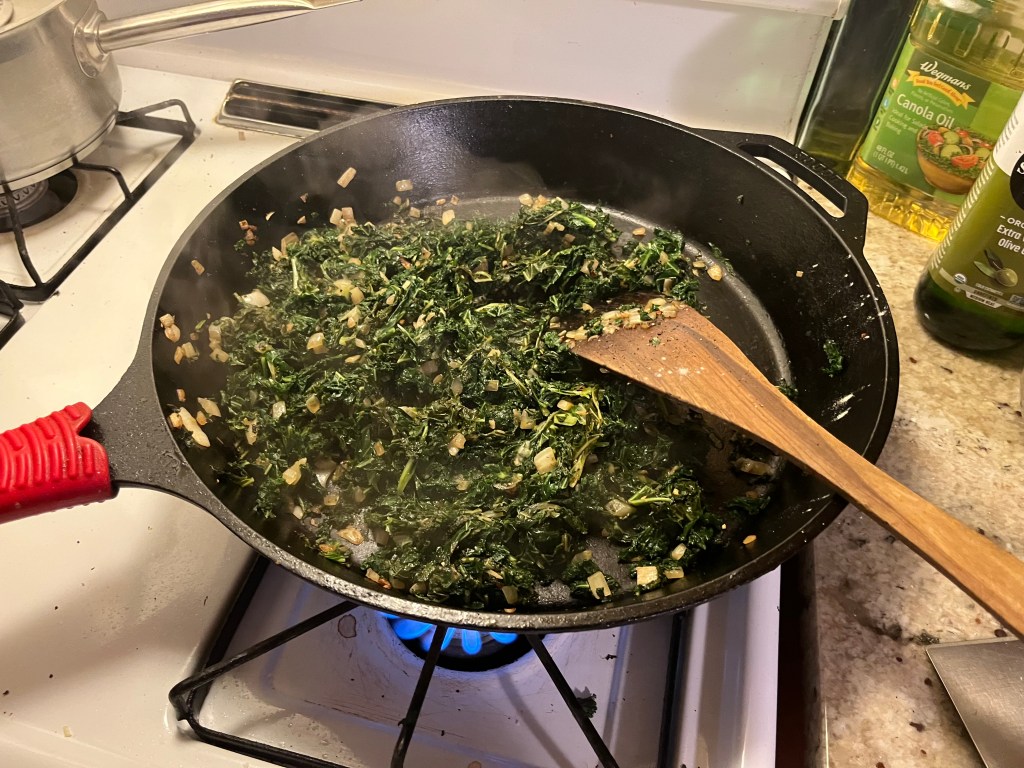
This recipe features a pork tenderloin cut into large cubes and marinaded in a smokey-spice paste with wine. The marinade has very little salt; I’ll have to see what Harold McGee has to say about salt in marinades, but I normally think of brining pork as a good thing. (McGee says that marinades use acidity to tenderize the meat and help it retain moisture while also infusing flavor. I think the reason the marinade does not use much salt is because the liquid is traditionally added back into this dish to form the broth. Brines typically have a high salt content, meaning one could easily over-salt this dish if the marinade is also a brining liquid and that is added to the broth. At the same time, I would recommend adding as much salt as you think the dish will later need to the marinade as it should only improve the meat and dish, especially if the salt is added to the paste rather than after the wine if poured over.) The dish and a side of “Sautéed Kale with Pine Nuts and Onions” took about 3.5 hours to make.
Cooking Notes: Select small new potatoes. You may also notice that the image in the book depicts more traditional roasted potato cubes, which I’d like to try next time. I would add salt to the marinade as the pork came out dry. When browning the pork, don’t use too high of heat as the marinade has lots of garlic in it that will turn into a black glob of carbon (or just be careful to remove this glob.) When cooking, make sure the pork is evenly submerged and try to cook it to temperature (so add it later to the pan than the clams and experiment with a thermometer. Also, maybe add more liquid if you’ve lost more than expected.) I cooked a lot of the liquid out of the kale and liked this. If you are using cider vinegar instead of wine, go easy on it and taste frequently. Remember to heavily salt the water for your kale.
Tasting Notes: The sauce and clams in this dish were amazing! The pork was dry and tough though; this cut needs more attention during the cooking than I gave it. The most popular English versions of this dish online actually braise the pork, so that may be worth trying. It could be that the traditional version, which uses the loin, has somewhat chewy and dry pork. The kale seems fairly superfluous; I was mostly hunched over the clam and pork bowl without remembering this side, but I’m glad I made a green vegetable nonetheless. Going to try to make some “heavenly” salt-cod the next time I cook from this book, I think!






 Joe Cook Me